

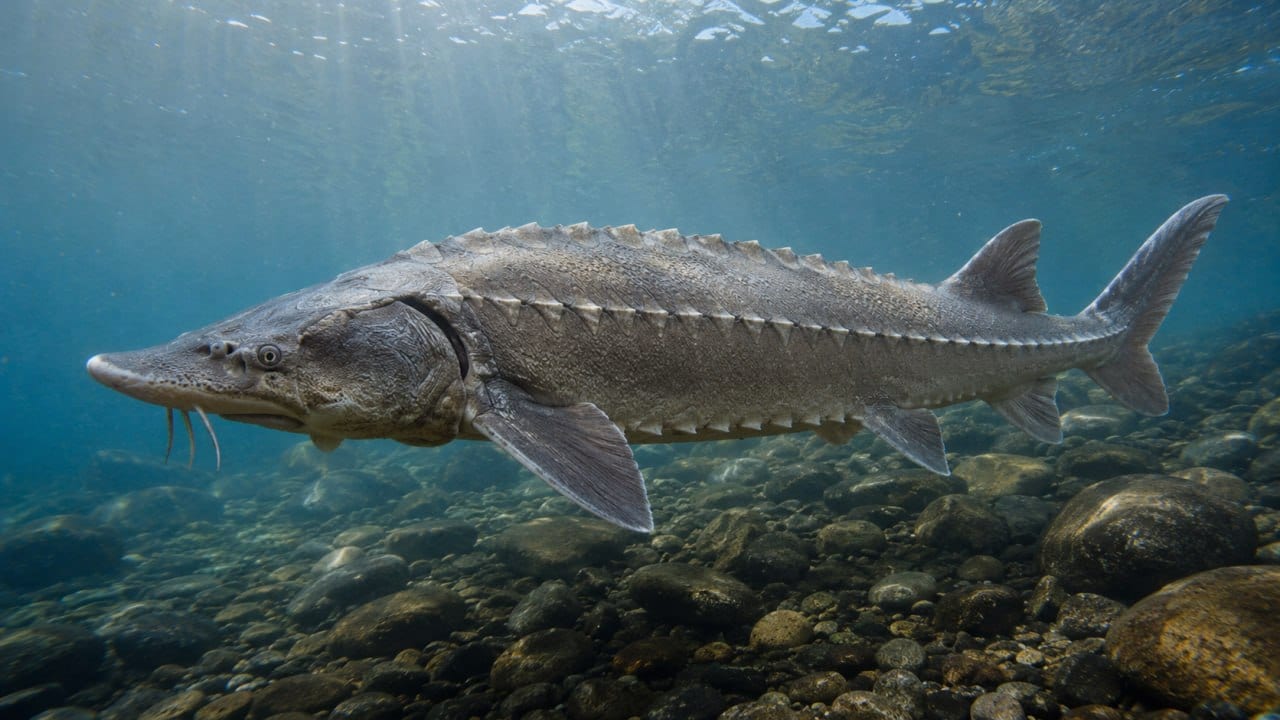
New Study Reveals Lake Sturgeon Can Live 400 Years in Michigan Great Lakes
Groundbreaking research shows lake sturgeon in the Great Lakes can live up to 400 years, making them one of the longest-lived fish species on Earth.
Imagine a fish swimming in the Great Lakes today that was alive when the Pilgrims landed at Plymouth Rock.
A groundbreaking new study reveals that lake sturgeon—massive prehistoric fish sometimes called "living dinosaurs"—can live up to 400 years in Michigan's Great Lakes.
That's not a typo. Some of these ancient fish swimming in our waters right now may have been alive before Michigan even had its first permanent European settlers.
A New Way to Measure Age
For decades, scientists estimated lake sturgeon age by examining growth rings in their fins—similar to counting rings on a tree. But this method had limitations.
"The older a fish gets, the harder it is to accurately determine its age using those growth rings," said Edward Baker, manager of the Michigan Department of Natural Resources' Marquette Research Station. "As fish age, they tend to grow slower and those rings become very indistinct."
Baker, who has studied lake sturgeon since the 1990s, said the prevailing belief early in his career was that most lake sturgeon lived only 50 to 60 years.
The Research Method
Researchers relied on decades of catch-and-release data from five fish populations across the upper Great Lakes. By catching, tagging, and releasing lake sturgeon over many years, scientists measured the same fish multiple times and developed a new growth rate equation.
"Some of the fish we have were growing two millimeters a year," Baker explained. "That's hard to measure if you're catching fish three or four years apart. We really needed that 10, 20, or 30-year difference between initial marking and recapture to have measurable change in length."
Staggering Lifespan Results
Using the new growth rate formula, researchers found lake sturgeon live much longer than anyone imagined:
• Male sturgeon: 90 to 279 years
For perspective, the previous oldest recorded lake sturgeon was estimated at just 152 years old.
These findings put lake sturgeon nearly on par with the Greenland shark—the longest-lived vertebrate on Earth.
Why This Matters for Michigan
Lake sturgeon have been around since before the Great Lakes even formed. These ancient creatures are a living connection to Michigan's prehistoric past.
But their future is fragile. According to Baker, less than 1% of the Great Lakes' historic lake sturgeon population remains.
Once considered a nuisance fish, lake sturgeon were heavily harvested during the late 1800s—nearly wiping out the species entirely.
"The sturgeon that we have in the Great Lakes left today are probably those young ones that survived all of that indiscriminate harvest and made it past 1910," Baker said. "They're now reproducing members of populations."
Conservation Efforts in Michigan
The study reinforces the need for strict protections across the Great Lakes. Lake sturgeon don't reproduce quickly, and they don't add new members to their populations easily.
Michigan has several conservation programs working to protect and restore lake sturgeon populations:
• Wolf Lake Fish Hatchery in Mattawan raises lake sturgeon for restocking
How You Can Help
A fish that can live for centuries takes generations to replace. Every lake sturgeon is important to the health of the Great Lakes ecosystem.
Here's how Michiganders can help protect these ancient creatures:
• Support conservation efforts through the Michigan DNR
Visit the Wolf Lake Fish Hatchery
Want to see these prehistoric giants up close? The Wolf Lake Fish Hatchery in Mattawan offers visitors a chance to spot massive lake sturgeon gliding along the bottom of the hatchery's show pond.
It's a rare opportunity to connect with a creature that has survived on Earth for millions of years—and might live to see the year 2400.
Frequently Asked Questions
How long can lake sturgeon live?
Why are they called "living dinosaurs"?
How did scientists discover their true lifespan?
Are lake sturgeon endangered?
How can I help protect lake sturgeon in Michigan?
Source: WWMT News Channel 3 Study published in the Journal of Fish Biology |
4 Comments
Join the conversation
Very interesting.
So wild to think there's sturgeon in Lake Michigan older than the U.S. Itself.
Rick P.It really is! Makes me wonder what those fish have seen swimming around down there all this time. Hard to wrap my head around living that long.
It's truly remarkable, some of these incredible lake sturgeon may have been alive before the founding of our country, connecting us directly to the region's deep natural history.